If you’ve ever worked in metal fabrication, automotive repair, or heavy machinery maintenance, you’ve probably encountered warped metal—whether it’s a twisted frame rail on a vintage truck, a bent industrial shaft, or a warped steel plate that’s thrown off an entire production line. For decades, the hydraulic press has been the go-to tool for fixing these issues, and as someone who’s supplied hydraulic presses for 12 years, I’ve seen just how transformative a proper straightening job can be when done right. A lot of folks think it’s just “crushing metal back into shape,” but that’s a dangerous oversimplification. Skip the brute force and the guesswork—follow this step-by-step guide, and you’ll get consistent, long-lasting straightening results without damaging the material. гидравлический пресс

First, let’s talk about why hydraulic presses work so well for straightening. Unlike a vise, a hammer, or even a heavy sledge, a hydraulic press delivers gradual, controlled force—usually measured in tons, from 10-ton benchtop models for small parts up to 500-ton+ industrial units for I-beams or large axles. The key is that the force is applied slowly, over a specific area, instead of the sudden impact of a hammer or the uneven pressure of a misaligned vise. This lets you bend metal back without causing micro-cracks, hardening, or warping the opposite side, which are common mistakes with less precise tools. I’ve seen new DIY mechanics grab a press and yank down on the ram only to split a ¼-inch steel plate or bend a shaft so far it snapped entirely—don’t be that person.
Before you even fire up the press, you need to do your prep work. This is the step most people skip, but it’s 80% of the battle. Start by inspecting the warped part thoroughly. Run your hand along the length of it, or use a straight edge and feeler gauges to map exactly where the bend is, how severe it is, and if there are any hidden flaws—like cracks, rust, or previous welds that could fail under pressure. For example, a bent truck axle that also has a rusted hairline crack won’t just straighten if you put 20 tons on it; that crack will grow, and the axle will break when you drive it. Mark the high points (the areas that stick out) and low points (the areas that dip in) with a marker, so you know exactly where to target the force.
Next, gather your press tooling. This is non-negotiable, and it’s where a lot of new users cut corners. You’ll need a hydraulic press bed (the flat steel plate at the bottom of the press), support stands or V-blocks, and various punches, dies, and spacers. V-blocks are perfect for round parts like shafts or axles because they cradle the part evenly and keep it from rolling during the process. For flat parts like frame rails, use rectangular support blocks that sit under the ends of the warp, not under the high points you’re pressing down on. If you support the part under the area you’re pushing, you’ll just bend it more in the middle. Always make sure the supports are stable and level—wobbly supports lead to uneven force and ruined parts. I keep a set of interchangeable tooling in my warehouse, from small 2-inch punches for small engine parts up to 12-inch wide dies for large steel beams, and I always advise my customers not to use random pieces of steel pipe or scrap as tooling. They can bend or crack under pressure, and if they fly off, they’re a safety hazard.
Once your part is prepped and tooling is in place, it’s time to set up the press. Position the part so the warp is centered between the supports, and align the ram (the moving end of the press) directly over the high point of the bend. Double-check your alignment—most hydraulic presses have a gauge that shows the position of the ram, and a lot of new users line it up roughly and end up applying force to the wrong spot. If you’re straightening a long part, it’s often better to make multiple small adjustments instead of trying to fix the entire bend at once. For example, a 6-foot steel beam that’s bent 2 inches in the middle won’t straighten with a single 50-ton push. You’ll make a ¼-inch adjustment, check the part, then move to the next small section, until you gradually work out the entire warp.
Now, the actual pressing step. This is where you control the force, not the speed. Slowly activate the hydraulic pump, and watch the pressure gauge closely—don’t just jam the ram down. For most steel parts, you want to apply force until you see the high point start to bend, then back off just a tiny amount—metal has “memory,” and if you over-bend it, it will spring back, sometimes more than you expect. A good rule of thumb for mild steel is to bend it 10-15% past the desired straightness to account for springback. For harder metals like alloy steel or aluminum, you’ll need less over-bend, because aluminum is more malleable and alloy steel can be brittle if bent too far. After each small press, release the pressure on the ram, carefully remove the part, and check its straightness. This is why I always tell my customers to use a straight edge every time—eyeballing it is never enough. A part that looks straight at first will often have a subtle curve that will cause problems down the line, especially for high-stress parts like axles or shafts.
Safety is non-negotiable here, too. Hydraulic presses are powerful—even a 20-ton model can exert enough force to crush a hand or bend a thick steel plate into a pretzel. Always wear safety glasses, work gloves, and steel-toe boots. Never put any part of your body between the ram and the press bed, and never try to straighten a part that’s too large or too thick for your press’s capacity. I get calls every month from someone who tried to use a 10-ton benchtop press to straighten a truck axle, and they ended up bending the press frame itself. When in doubt, step up to a higher tonnage unit—most of my customers who work with heavy industrial parts start with a 100-ton floor model, which gives them plenty of flexibility without being too big for small jobs.
Once you’re happy with the straightness, do a final inspection. Run the straight edge along the entire length of the part, check for any new cracks or dents, and make sure all welds or attachment points are intact. For parts that will see heavy use, like automotive frame rails, a magnetic particle test or ultrasonic test can catch any hidden micro-cracks that would show up under load, but that’s an extra step for specialty applications. For most jobs, a simple visual check and straight edge test is enough to ensure the part will hold up.
Now, a few common mistakes I see all the time, and how to avoid them. First, don’t straighten a part when it’s cold if it’s made of high-carbon steel or alloy steel. Cold straightening can cause work hardening, which makes the part brittle and prone to breaking later. For these metals, heat the bend area to around 500-600 degrees Fahrenheit (don’t cherry red it—you just need it to be warm to the touch, not glowing) before pressing. This relieves internal stress and makes the metal more malleable, so it bends evenly instead of cracking. Second, never use too much force too fast. Rushing the job leads to over-bending, cracks, or damaged tooling. Take your time, make small adjustments, and check frequently. Third, don’t support the part under the bend—this is the fastest way to ruin a part. Always support the ends, or the areas away from the warp, so the force is applied exactly where you need it.
If you’re new to using hydraulic presses for straightening, start with small, simple parts. Practice on a scrap piece of steel or aluminum first, so you get a feel for how different metals react to pressure and how much springback to expect. Once you’re comfortable, move to larger parts. And if you’re in the market for a hydraulic press, I can’t stress enough how important it is to get the right size and model for your needs. A 20-ton benchtop press works great for small engine parts and metal fabricating jobs, but if you’re working on heavy machinery, large axles, or steel beams, you need a higher tonnage industrial press that’s built to handle consistent, heavy-duty use.
At the end of the day, hydraulic press straightening is a skill that comes with practice, but it’s also one of the most efficient ways to salvage damaged metal parts, instead of having to cut them out and replace them. Whether you’re a small auto repair shop, a large metal fabrication plant, or a hobbyist who works on old trucks, a well-used hydraulic press can save you thousands of dollars in replacement parts and downtime.
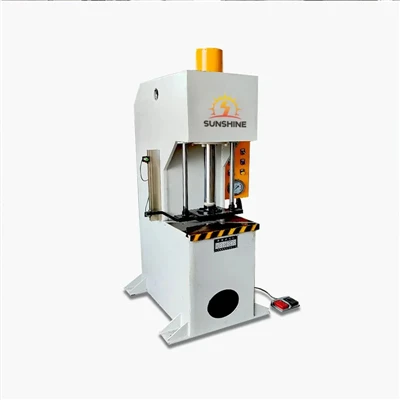
If you’re ready to invest in a hydraulic press for your straightening needs, or if you have questions about which model is right for your specific applications, don’t hesitate to reach out. I’ve been helping shops of all sizes find the right hydraulic press solutions for over a decade, and I’m here to help you get set up with the right equipment, tooling, and guidance to do straightening jobs safely and effectively.
Vertical Machining Center REFERENCES
- ASM International. (2005). Metals Handbook: Volume 4: Heat Treating. ASM International.
- Machinery’s Handbook. (31st ed.). Industrial Press, Inc.
- Oberg, E., Jones, F. D., Horton, H. L., & Ryffel, H. H. (2016). Machinery’s Handbook: A Reference Book for the Mechanical Engineer, Designer, Manufacturing Engineer, Draftsman, Toolmaker, and Machinist. Industrial Press, Inc.
- Hough, G. L. (2019). Hydraulic Press Operations for Metal Forming and Straightening. Journal of Industrial Maintenance and Repair, 45(2), 32-38.
Shandong Sunshine Machinery Co., Ltd.
With abundant experience, we are one of the most professional hydraulic press manufacturers and suppliers in China. We warmly welcome you to buy discount hydraulic press for sale here from our factory. All customized machines are with high quality and competitive price.
Address: No. 831 Shangdu, Xingtan Road, Jinghe Street, Tengzhou City, Zaozhuang City, Shandong Province
E-mail: linna.sunshinemachinery@gmail.com
WebSite: https://www.sunshine-machinery.com/
