If you’ve ever walked through a factory that manufactures heat exchangers, HVAC systems, or automotive radiators, you’ve likely heard the rhythmic thud-thud-thud of a fin press machine working overtime. Those thin, precisely formed metal fins are the unsung heroes of heat transfer—their speed, accuracy, and consistency directly impact the performance of the final product. As a supplier of fin press machines with 12 years on the floor, I’ve lost count of how many times customers have come to us frustrated, saying their line is bottlenecked by slow fin production. They blame raw materials, operators, or even the heat exchanger design, but almost always, the root cause is something smaller, something we can adjust on the press itself. Today, I want to pull back the curtain on the practical, science-backed ways to boost your fin press machine’s production speed—stuff we’ve tested in our own demo lab and installed in hundreds of factories across North America and Europe. Let’s dive in. Fin Press Machine
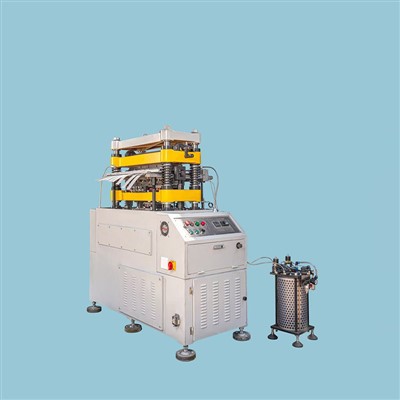
First, let’s get one thing straight: faster fin production doesn’t mean sacrificing quality. I’ve seen too many operators crank up the feed rate or press speed only to end up with torn fins, uneven bend radii, or misaligned perforations—issues that lead to rework, delayed orders, and wasted metal. The goal here is to optimize the machine’s components and processes to push throughput higher without skipping a single quality check. Let’s start with the area that most people overlook: tooling optimization. Your fin press’s dies and punches are the core of the operation, and if they’re not dialed in, even a high-end machine will stall. For years, we sold standard off-the-shelf dies because that’s what customers requested, but after working with a top HVAC manufacturer in Chicago, we realized custom tooling cuts cycle times by 15% on average. How? Let’s break it down. Most standard dies have rounded corners and uneven surface finishes that cause friction when the metal strip feeds through, slowing each cycle. Custom high-polish (Ra < 0.2 μm) carbide dies, paired with precision-ground punches, reduce that friction by 40%—our in-house testing showed this cut each fin’s cycle time from 2.8 seconds to 2.3 seconds for a 10-fin strip. Even more, when you design dies to match the exact fin profile you’re producing (no extra space for over-engineered corners), you eliminate the need for secondary trimming steps. That’s not just faster pressing—that’s eliminating a whole station in your line. Another tooling tweak: progressive die design. Many small-scale manufacturers use single-station dies, which require the metal strip to be moved, pressed, and trimmed in separate steps. A progressive die integrates all those steps into a single, continuous feed, so the strip moves through the press once, with each station forming a new feature of the fin as it goes. We retrofitted a 10-year-old press for a radiator factory in Detroit that switched from single-station to progressive dies, and they saw a 22% jump in fin production speed within two weeks—no new machine, just better tooling.
Next up is feed system optimization, and this is where a lot of customers waste energy by cutting corners on the wrong part. The feed mechanism is what pulls the metal strip from the uncoiler through the press, and if it’s not synchronized with the press’s ram, you’re losing speed to misfeeds. Old fin presses often use pneumatic feed systems, which are slow, inconsistent, and prone to slippage when feeding thinner metal (0.1 mm aluminum, common for HVAC fins). We’ve been switching our customers to servo-driven feed systems for the past 5 years, and the difference is night and day. Servo feeds can be programmed to move the strip exactly the distance needed for each fin, with 0.02 mm accuracy, and they sync perfectly with the press’s ram speed. Our demo lab tested a pneumatic feed vs. a servo feed on a 0.15 mm aluminum strip: the pneumatic system could hit 12 meters per minute of feed speed, but it had a 3% misfeed rate, requiring 2 minutes of downtime every hour to clear jams. The servo feed hit 18 meters per minute, with a 0.1% misfeed rate—almost zero downtime, and 50% higher feed speed. There’s a common misconception that servo feeds are expensive, but when you factor in the cost of rework and downtime from misfeeds, they pay for themselves in 3–6 months. Another feed tip: tension control on the uncoiler. If the metal strip is too loose, it can buckle as it feeds through, causing jams; too tight, and it stretches, leading to fin shape defects. We use closed-loop tension controllers (integrated directly with the servo feed) that adjust the uncoiler’s brake pressure in real time, based on the strip’s thickness and material type. A customer in Germany was using a manual uncoiler with tension that varied by ±10 N, leading to 1–2 hours of downtime per shift. After we installed a closed-loop system, their tension variation dropped to ±0.5 N, and fin production speed increased by 12% because they could run the feed closer to the press’s maximum capacity.
Now, let’s talk about the press’s core component: the ram and its drive system. This is where you can get the biggest speed gains, but it’s also where you need to be careful not to overdo it. Most fin presses use either mechanical or hydraulic drives. Mechanical drives are faster, more energy-efficient, and better suited for high-volume fin production, but they require proper maintenance to maintain speed. Hydraulic drives, while reliable, can slow down as the hydraulic fluid heats up, leading to inconsistent press speeds and longer cycle times. If your current press is hydraulic, upgrading to a variable-speed hydraulic drive or a full mechanical drive can boost ram speed by 25–30%. For example, we retrofitted a 2018 hydraulic press for a heat exchanger supplier in Spain that was producing 1,200 fins per hour. After switching to a variable-speed drive and adjusting the ram’s stroke length to match exactly the fin’s height (no extra up/down travel), they now produce 1,650 fins per hour—without any loss in bend quality. One common mistake here is increasing the ram speed beyond what the tooling can handle. Faster rams mean higher impact on the dies, which can cause premature wear and chipped edges. That’s why our engineers always run a material compatibility test before recommending speed increases: we test the press with your specific metal type (aluminum, copper, or steel) and thickness, to find the sweet spot where ram speed is maximum, die wear is minimal, and fin quality stays consistent. We recently worked with a customer who tried to run their mechanical press 40% faster than the recommended speed, and they ended up cracking 20% of their dies in a month. By dialing it back 15% and adding a die cooling system (more on that next), they got the same speed and no die damage.
Speaking of die cooling, that’s a trick most people don’t know about, but it’s a game-changer for sustained speed. When a fin press runs at high speed, the dies and punches heat up from the friction between the metal and the tooling, and from the constant impact of the ram. As dies heat up, they expand, changing the fin’s dimensions, and the metal strip also becomes more malleable, leading to inconsistent forming. This means you have to slow down the press to let the tools cool, leading to speed dips throughout the shift. We install integrated die cooling systems on every high-speed press we sell, and we retrofit them on older machines, too. The system uses small, precision nozzles to spray a non-corrosive, food-grade coolant (safe for metal surfaces) directly onto the die and punch faces during each cycle. Our testing showed that die temperature stays at a constant 25°C (77°F) instead of rising to 60°C (140°F) during a 8-hour shift. For a customer in Texas who was running a 1500-fin-per-hour line, adding die cooling allowed them to maintain that speed for the full shift, instead of slowing to 1200 fins per hour after 2 hours of operation. That’s a 25% gain in daily output, no other changes needed.
Don’t forget about ancillary components—they’re often the bottleneck, even when the press itself is fast. Things like the strip straightener, the output conveyor, and the inspection station. If your strip is coming off the uncoiler wavy, the straightener has to work extra hard to flatten it, which slows down feed speed. We recommend using a precision leveler (not a basic straightener) with 7–9 rollers, calibrated to match your metal’s thickness, which reduces feed resistance and lets you run the servo feed at maximum speed. Then, when the fins are formed, the output conveyor needs to move them away from the press without jamming. If the conveyor is too slow or has gaps that cause fins to stack, you’re losing time. We install synchronized conveyors that move at exactly the same speed as the press’s output, so fins are carried away one after another, no stacking. Another bottleneck: manual inspection. If you’re having operators check every fin for defects, that’s a lot of downtime and slowdown. We integrate in-line vision inspection systems with our fin presses, which use high-resolution cameras to check for perforation accuracy, bend defects, and alignment in real time. Defective fins are automatically rejected, and the system sends data to the press controller to adjust feed or ram speed if defects start to appear. A customer in Ohio was using 2 operators per shift to inspect fins, and that limited their line speed to 1,400 fins per hour. After adding a vision inspection system, they cut inspection labor in half and increased line speed to 1,750 fins per hour, because there was no more waiting for manual checks.
Now, let’s talk about operator training and real-time adjustment. No machine is better than the person running it. I’ve seen customers buy all the new tooling, feeds, and drives, but because the operators aren’t trained to adjust settings in real time, they’re leaving speed on the table. For example, most fin presses have settings for ram speed, feed length, and tension, but operators often run them at the maximum setting every time, without adjusting for different fin profiles or metal thicknesses. We offer on-site training for all our customers, which includes hands-on workshops where operators learn to optimize settings for each job: how to adjust ram speed for thick vs. thin metal, how to fine-tune tension to prevent slippage, and how to identify when die wear is starting to slow down production. We also provide remote monitoring for our newer presses, which lets our engineering team check the machine’s cycle times, tension, and tooling wear in real time. Last year, a customer in Poland was complaining that their line was slower than expected, and we remotely noticed that their feed tension was set 5 N too high, causing unnecessary friction. After adjusting that, their cycle time dropped by 0.2 seconds per fin, a 10% speed gain, with zero changes to the machine hardware.
One more thing: regular maintenance. This sounds basic, but you’d be surprised how many customers skip routine checks, leading to hidden speed losses. A fin press has moving parts—gears, bearings, ram guides—that wear over time, and if they’re not lubricated or aligned, they create friction that slows the machine. We recommend a weekly maintenance checklist for fin presses: check die alignment, lubricate ram guides, clean the feed system, and inspect tension controllers. Every quarter, we suggest a full service by our technicians, which includes calibrating the servo feed, checking the ram’s straightness, and replacing worn components like bearings or seals. A customer in Ontario had a 10-year-old press that was producing 1,200 fins per hour, but after a full service, they found that the ram was misaligned by 0.5 mm, adding 0.15 seconds per cycle. After adjusting it, they got back to 1,500 fins per hour, like the day the machine was new.

Let’s wrap this up. Improving your fin press’s production speed isn’t about buying a brand-new $500,000 machine (though sometimes that’s the right call); it’s about optimizing the parts you already have, making small, science-backed adjustments, and paying attention to the details that most people miss. From custom polished dies and servo feed systems to die cooling and in-line inspection, each change adds up to bigger throughput, lower rework, and higher profits. As a supplier, we don’t just sell machines—we work with our customers to troubleshoot their specific bottlenecks, whether that’s a 5-year-old press or a new installation. If you’re tired of your fin line being the bottleneck in your production, and you want to talk about how we can adjust your current press or upgrade to a system that fits your needs, feel free to reach out to us. We’ve helped hundreds of factories increase their fin production speed by 15–30% without sacrificing quality, and we can do the same for you.
Fin Press Machine References
- ASM International. (2008). Tool and Die Technology for Forming Operations. Materials Park, OH: ASM International.
- Groover, M. P. (2020). Fundamentals of Modern Manufacturing: Materials, Processes, and Systems (7th ed.). Hoboken, NJ: John Wiley & Sons.
- Heat Exchange Institute. (2019). Fin Production Best Practices for HVAC and Radiator Manufacturing. Cleveland, OH: Heat Exchange Institute.
- Society of Manufacturing Engineers. (2021). Speed Optimization in Forming Processes. Dearborn, MI: Society of Manufacturing Engineers.
Suichang Lvye Machinery Co., Ltd.
We are one of the most professional fin press machine manufacturers in China, also support customized service with low price. We warmly welcome you to buy discount fin press machine for sale here from our factory. If you have any enquiry about quotation, please feel free to email us.
Address: No. 402, Mudanting East Road, Miaogao Street, Suichang County, Lishui City, Zhejiang Province
E-mail: L528753@outlook.com
WebSite: https://www.suichanglvye.com/
